
Test the deferred deep linking that keeps your payload intact.
Book a DemoFor a decade, “going viral” has been treated as a marketing phenomenon — a lightning-in-a-bottle moment of cultural luck. But for the most successful mobile apps in the world, virality is not magic; it’s a product of rigorous, first-principles engineering.
True, sustainable growth isn’t achieved by chasing trends, but by building closed, self-perpetuating systems where users create the next cohort of users simply by engaging with the product. We call these viral loops for mobile apps.
I am the CTO of Tapp, and this is not a marketing guide about social media hashtags. This is an engineer’s playbook for building defensible, product-led growth engines. We are going to move beyond high-level advice and break down the mechanics of virality, from the mathematical models that govern it to the practical implementation of the deferred deep linking infrastructure that makes it possible.
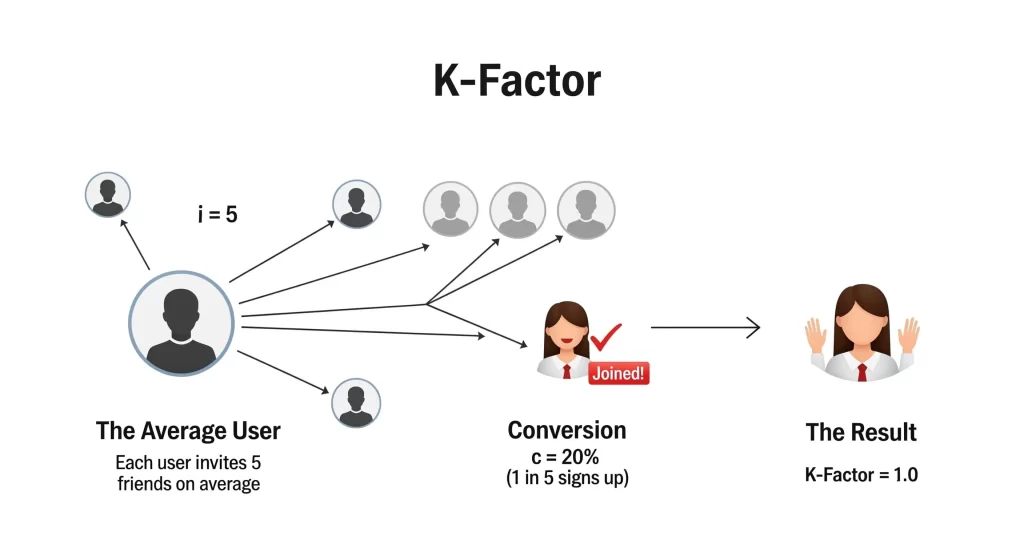
At its core, virality is a mathematical concept. It can be measured, modeled, and optimized through a simple but powerful formula. The viral coefficient, commonly known as the K-factor, quantifies, on average, how many new users each existing user successfully brings into your product.
Let’s illustrate. Imagine your app has 1,000 active users. In one month they send 5,000 invitations (i = 5). Out of those, 1,000 result in a new sign-up (c = 1000 / 5000 = 0.2). Your K-factor: K = 5 × 0.2 = 1.0.
A K-factor of 1.0 is the holy grail of viral growth — every user brings in exactly one more, creating a self-sustaining system. But even a K-factor of 0.5 cuts your CAC by 33%, a massive, defensible advantage.
While K-factor measures the magnitude of your loop, there’s a third critical variable: Cycle Time — the time it takes for a newly acquired user to become an inviting user. A faster cycle time acts as an explosive accelerator, even if K stays the same.
After a month, App B will have executed 15 growth cycles while App A executed two. Shortening your cycle time by surfacing the referral UI earlier in onboarding is a high-leverage engineering optimization.
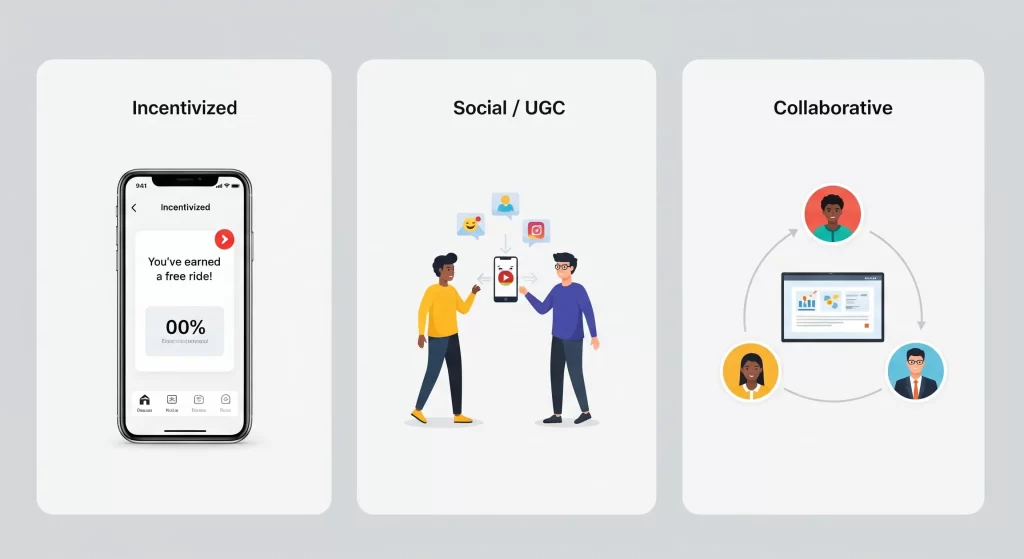
Not all viral loops are created equal. They are designed around different user motivations and API architectures. Understanding the types is key to identifying which to build.
Architecture: You offer a direct incentive (in-app currency, premium access) contingent on the invited user completing a specific payload event, like creating an account.
examples · Dropbox (“Get 500 MB free”), Robinhood (“Get a free stock”)
Architecture: A user creates content (a video, a high score) and shares it externally. The shared content links back to your app via a deep link, driving new users to recreate the experience.
examples · TikTok (every shared video is a viral vector), Strava (shared activity maps)
Architecture: To complete a task, a user must invite someone. Sharing is not optional — it is a mandatory part of the core workflow.
examples · Figma (share to collaborate), Slack (a workspace is useless alone)
Regardless of which loop you build, its success rests on a single non-negotiable requirement: a 100% reliable, deterministic deferred deep linking system. Without it, you cannot measure your K-factor or reliably trigger webhook rewards. Your data will be flawed and your loop will collapse.
The primary enemy of mobile virality is the “App Store Black Box.” When User A texts a referral link to User B, the data payload is often destroyed:
Here is a practical framework for your product and engineering teams to follow when building your loop.
Before writing a single line of code, identify the “aha!” moment in your app. Where is the user happiest? Ask for the referral there, not blindly on the home screen.
The core engineering task. Use the Tapp SDK (Native, React Native, and Flutter) to dynamically generate unique referral URLs, pass metadata payloads, and track the full funnel from invite to activation. See my guide on How to Track a Viral Loop with Tapp.
You cannot improve what you cannot measure. With Tapp’s deterministic data flowing into your database via webhooks, treat your viral loop like any engineering project — relentlessly reduce cycle time and increase conversion rates.
A K-factor greater than 1.0 signifies exponential, self-sustaining growth, but this is exceptionally rare. A “good” K-factor is any value greater than 0 that meaningfully reduces your blended CAC. A K-factor of 0.2 is valuable, and 0.5+ is excellent.
Absolutely. Social (UGC) and Collaborative loops are entirely non-incentivized. They are powered by a user’s intrinsic motivation to share their creations or to use the product more effectively with teammates — often the most defensible loops.
Because of the “App Store Black Box.” Without a deferred deep linking infrastructure, you cannot reliably attribute a new install back to the specific user ID who sent the invitation, making it impossible to calculate K-factor or trigger programmatic rewards.
Virality is an engineered outcome. Stop worrying about the complexities of attribution and start focusing on the UX of your loop — Tapp handles the deferred deep linking so payloads are never lost.
Create a Free Staging AccountFor a breakdown of the psychology behind these models, read Samuel’s guide: 10 Viral Loop Examples from Top Apps.